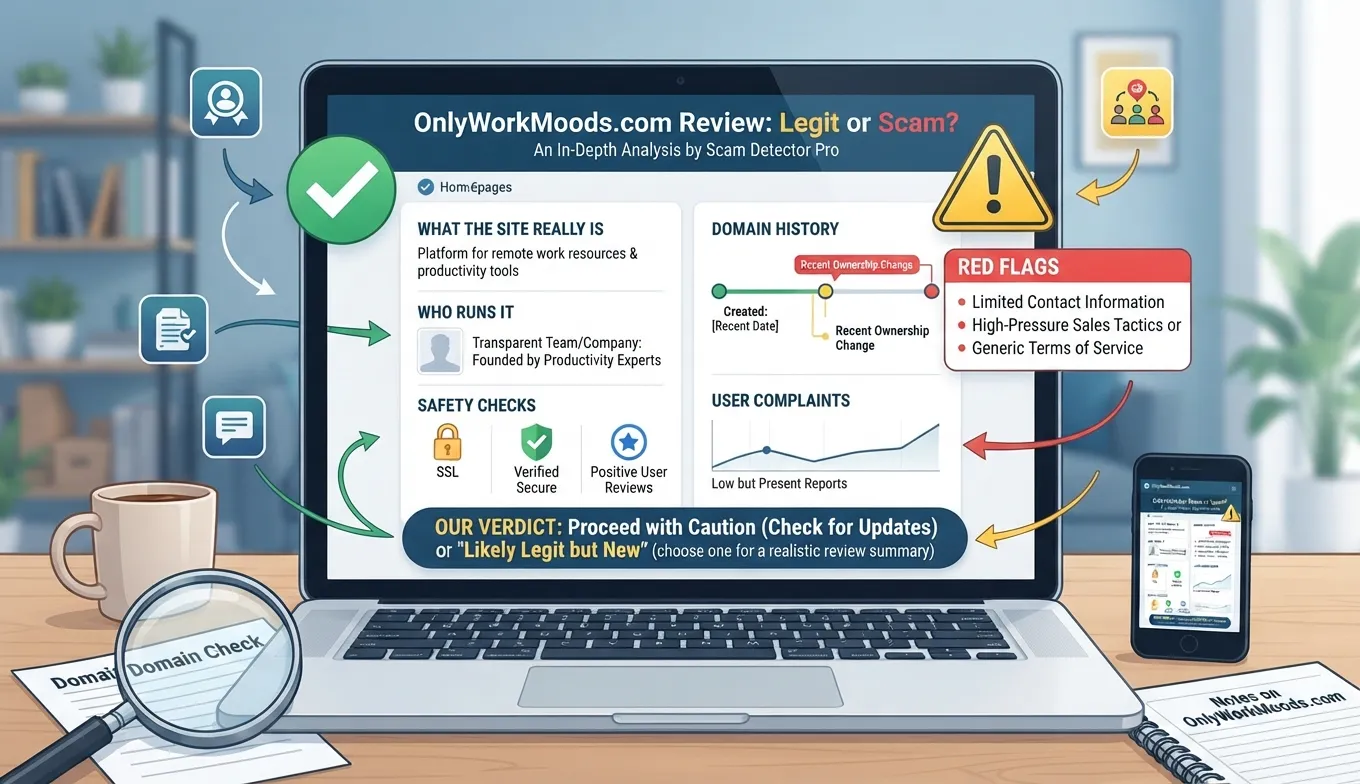
OnlyWorkMoods.com Review: Is It Legit, Safe, and Worth Your Time?
Here is the short version of this onlyworkmoods com review. The site is not an app. It has no mood tracker and no login. This is a small blog that puts out short posts on careers, work habits, and a grab bag of other topics. The domain was registered in March 2023, and the public checkers I tried gave it an average-to-good trust score. What bugs me is that there’s no author info anywhere, and the topic list is huge with very little to back it up.
Honestly? It’s fine for light tips. I just wouldn’t lean on it for anything health, money, or legal. That’s where thin writing and no sources can actually cost you. Next I’ll cover the domain details, the content, and a few quick safety checks. I’ll also point you to some better tools, because if you want to track sites properly, this isn’t the place to start.
Quick Verdict
| Question | Answer |
| Is it an app? | No, it’s a content site |
| Do I need an account? | No, articles open right away |
| Is it safe to browse? | Public checkers rate it low risk |
| Who runs it? | Nobody says |
| How deep is the content? | Light and general |
| Best use | Quick reading on work habits |
| Skip it if | You want a tracker or expert advice |
What Is OnlyWorkMoods.com?
Okay, so it’s just a blog. Nothing fancy. The posts are short and stick to work stuff: careers, staying focused, daily habits. A few independent reviews say it’s built on WordPress. There are legal pages, and you can actually reach the owner through a contact page. The site loads over HTTPS, and Cloudflare sits in front of it.
Quick note on Cloudflare, in case the name means nothing to you. It’s a service that handles traffic between a site and its visitors. Pages load a bit quicker, and some attacks get blocked before they reach the site. Lots of small blogs use it, so it tells you almost nothing about quality.
There’s no dashboard here. No mood log, no task list, no team tools. You open an article, you read it, you leave. The homepage pitches the site as a careers and workplace publication. Reviews say the real mix is wider than that. That gap is the first thing to understand before you trust anything on it.
Why the Name Confuses People
Say the name out loud. “Only work moods.” It sounds like software that tracks how you feel at your job. I get why people type it into Google expecting a sign in page.
And the idea isn’t silly. Work stress is real. The World Health Organization lists burnout as an occupational phenomenon in its ICD 11 guide. It describes workplace stress that nobody manages well. Employers and app makers talk about mood at work constantly now. A domain like this sounds like it belongs in that world.
It doesn’t. People come looking for a mood tracker, a login page, or an HR dashboard. The site has none of those. You get plain text articles, and the tips are meant for everyone, not tuned to your data.
Is there an onlyworkmoods com login?
No. Public listings show no user portal, no password box, and no account area. If a page claims to be an onlyworkmoods com login, be careful.
Scam sites love popular search terms. They build fake login screens to grab emails and passwords. Seen a form asking for your details on a site with this name? Close the tab. The real site has nothing to log into.
How Does the Site Work?
It works like a magazine rack. You land on an article from Google, or you open the homepage and pick a topic. You read. Maybe you click a related post.
That’s it. You never type in your own data, and the site never learns anything about you. A tool asks you to do something. A blog hands you something to read. This one is a blog.
Domain History and Ownership
Most competing reviews skip this part. I think it matters more than the homepage, because a domain’s past says a lot about what it was built for.
Domain age and registrar
Scamadviser puts the registration date at March 18, 2023. The registrar is Wild West Domains, and the renewal date is set for 2034, which is a long way off. Someone paid for years in advance. A separate independent review gives the same date. In October 2026, that made the domain about three and a half years old.
Other reviews disagree. Some say “over a year.” One says “about three years.” The public record points to 2023, so I’d go with that.
Domain age has a catch. The registry date resets if someone drops a domain and a new owner buys it again. To see older history, try the Internet Archive’s Wayback Machine. It saves old versions of web pages, so you can see what a domain hosted before.
A long prepaid registration tells you the owner plans to keep the name. It doesn’t tell you the content is good.
The CracksTube claim
One independent review says the site’s images load from a server named after CracksTube. The writer reads this as a sign of paid guest posting, not piracy. The same review says search traffic dropped sharply within a year, citing Ahrefs data.
I’d hold that loosely. It’s one source, and I couldn’t confirm it from the public record. It might be right. It might change tomorrow. Check the page source and a traffic tool yourself before repeating it.
What I can say is smaller. A site that borrows its images from another network isn’t building its own brand. That matches a pattern I see on a lot of low effort blogs.
READ MORE : MiloMagazine.co.uk: What It Is, Who Runs It, and Is It Legit in 2026
Who runs the site
Nobody says. The WHOIS data sits behind a privacy service. That’s legal and common, since many owners just want less spam.
The independent review also says every article carries the same single author name. No bio, no company, no team page. Other reviews flag the same problem. Google’s quality guidelines ask a plain question about any page: who made this, and why? Here, I can’t answer it.
What the Site Publishes
The topic list is huge. Reviews mention work, business, finance, health, education, lifestyle, fashion, technology, and travel. One review counts eleven sections. Another says some categories look thin next to that big menu.
That combination usually means a site built to catch search traffic. It grows by adding topics, not by going deeper on one.
Here’s how I’d use it. Articles on focus and work habits are low risk, so go ahead. Career and tech pieces are beginner level, so treat them as a starting point. Anything on business, money, or health is where I’d stop and look elsewhere. The closer a topic gets to your wallet or your body, the less you should lean on this site.
Content Quality
Writing is easy. Short sentences, plain words. A student or a beginner can follow it without effort, and I’ll give the site credit for that.
The problems are just as plain. Reviews describe general advice, almost no original research, no case studies, and few named sources. Older posts may never get updated.
You can test any article yourself in about five minutes.
- Find a named author with a real bio.
- Look for links to studies, agencies, or experts.
- Check the publish date and any update date.
- Pick one claim and test it against a trusted source.
- Ask yourself if the writer actually lived this, or just repeated common tips.
Google’s helpful content guidance talks about experience, expertise, authority, and trust. Most pages on sites like this score low on all four. “Take regular breaks” is fine advice. It’s also on ten thousand other sites.
Is OnlyWorkMoods.com Legit?
Yes, in the plain sense. It’s a real, working website. It doesn’t sell anything. It doesn’t ask for payment. It doesn’t need your personal data to let you read.
But legit and authoritative aren’t the same thing. A site can be real and still be thin.
BBB and Trustpilot
Other reviews found no verifiable Better Business Bureau profile and no meaningful Trustpilot page. That’s normal for a blog. Those platforms track companies that sell products or services.
One warning. Some searches for the brand name pull up Trustpilot pages for unrelated companies, like mood.com. Different business. Those reviews say nothing about this site.
A better test is the site itself. Check the About page, the Contact page, and the Privacy Policy. Reviews say the legal pages exist. What’s missing is a real person behind them.
READ MORE : Is Charfen.co.uk Legit? Honest 2026 Review and Safety Check
Is It Safe to Visit?
For normal reading, the risk looks low. Here’s what public checkers show, and what you should run yourself.
| Check | Source | Result |
| Trust score | Scamadviser | Average to good |
| SSL certificate | Scamadviser | Valid |
| DNS safety | DNSFilter, via Scamadviser | Marked safe |
| Domain age | WHOIS record | March 2023 |
| Safe Browsing status | Google Transparency Report | Run it yourself |
| Malware scan | VirusTotal | Run it yourself |
The first four rows come from public records. The last two change often, so check them on the day you visit.
Here’s the routine I’d follow.
- Make sure the address starts with https and shows a lock icon.
- Paste the domain into Google’s Safe Browsing check.
- Run it through VirusTotal.
- Don’t download anything from a content blog.
- Don’t type a password or card number into the site.
Also watch for pop ups that ask you to click “Allow” or “I am not a robot” in odd places. Those can be tricks to push notifications onto your device. If you see one, close the page.
The U.S. Federal Trade Commission has free guides on spotting online scams. They’re worth a look if you browse unfamiliar sites a lot.
Lookalike Domains: Check the Exact Address

One wrong letter can land you on a different site. A name might end in .net, .org, or .xyz instead of .com. A similar name doesn’t prove the same owner.
Some reviews link to an .org address when they talk about this site. I couldn’t confirm whether the .org and the .com share an owner. Until you see proof, treat them as two separate sites.
Watch for these red flags:
- Extra letters, hyphens, or a different ending in the address.
- A login box or payment form on a page that should only have articles.
- Buttons offering a file, an app, or an “update.”
- Countdown timers or urgent warnings.
Read the full address before you click anything. It takes three seconds and saves a lot of trouble.
READ MORE : MagzyMinutes.com Review 2026: Is It Legit and Worth Reading?
How the Site Likely Makes Money
It doesn’t sell a product. So the usual suspects for a blog like this are display ads, affiliate links, and paid guest posts. No review I found confirms which one it uses.
Short articles on many topics fit a traffic first plan. The goal is to rank for lots of searches, not to build a loyal audience. That’s my guess from the structure. It isn’t a confirmed fact.
Who Should Use It, and Who Should Skip It
Use the site if you:
- I want a quick, easy read on work habits.
- Are a student exploring career basics.
- Treat articles as ideas, not instructions.
Skip the site if you:
- Need a mood tracker or task tool.
- Want advice on health, pay, contracts, or law.
- Need sources you can cite in school or at work.
Better Options if You Wanted a Mood Tracker or Productivity App
If you came here hunting for software, these are real tools sorted by need. Check each one’s current features and pricing before you commit.
| Need | Option | What it does |
| Daily mood log | Daylio | Tracks mood with quick taps |
| Mood and symptom patterns | Bearable | Logs mood, sleep, and habits |
| Task planning | Todoist | Organizes tasks and deadlines |
| Career and management ideas | Harvard Business Review | Research based articles |
| HR and workplace policy | SHRM | Guidance from a professional body |
Frequently Asked Questions
What is OnlyWorkMoods.com?
It’s a content website with articles on work, careers, and general topics. It isn’t software, and it has no tracking features.
Is it a mood tracker or app?
No. There’s no dashboard, no mood log, and no account system. You only read articles.
Is it legit or a scam?
It’s a real, working blog. It doesn’t sell products or ask for payment. It’s weak on author details and depth.
Is it safe to visit?
Public checkers rate it low risk, and it uses HTTPS. Still, run your own scan, and never enter personal details.
Do I need an account?
No. Articles open without signing in. Any page asking for a login under this name deserves suspicion.
Who owns it?
Nobody says. The WHOIS data is private, and the articles carry almost no author detail.
How old is the domain?
Public records show it was registered on March 18, 2023. That makes it about three and a half years old.
Are the .com and .org versions the same site?
I couldn’t confirm that. Check the full address each time and treat them as separate sites.
Is the information reliable?
It’s fine for light tips. Check anything about health, money, or law with an expert source.
Final Verdict
I’ll be honest, the name OnlyWorkMoods.com threw me off. It sounds like a mood tracker, maybe an app with a login. It’s not. It’s just a blog, with posts on careers, work habits, and a few random topics thrown in.
The domain dates back to March 2023, so it’s around three and a half years old. The owner is hidden. Every article is signed by one author, and there’s no bio anywhere. Public checkers call the site low risk, and it does use HTTPS. Still, I’d run my own scan before trusting it.
The writing is easy to read, but it’s thin, and sources are rare. Fine for light tips. Health, money, or legal stuff? Go somewhere else. And if you wanted a mood tracker, Daylio or Bearable are the better pick.